

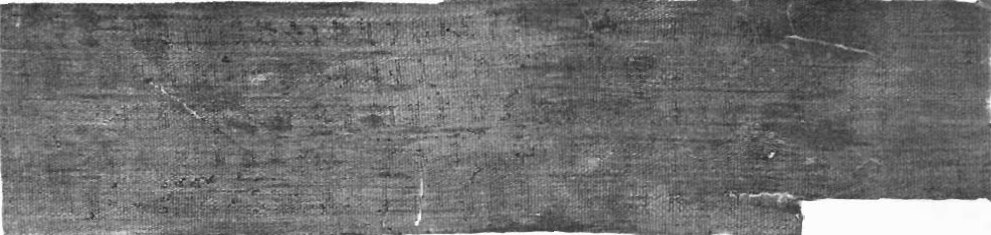

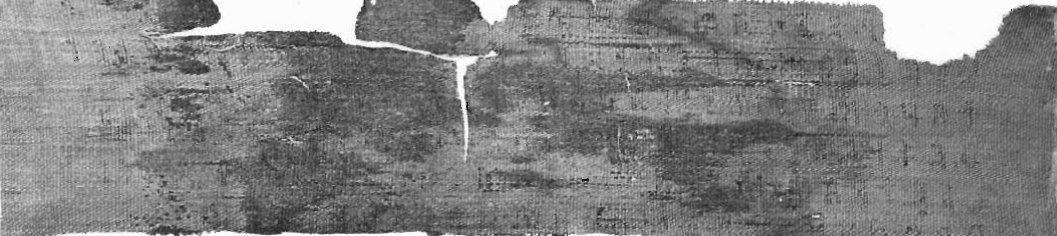
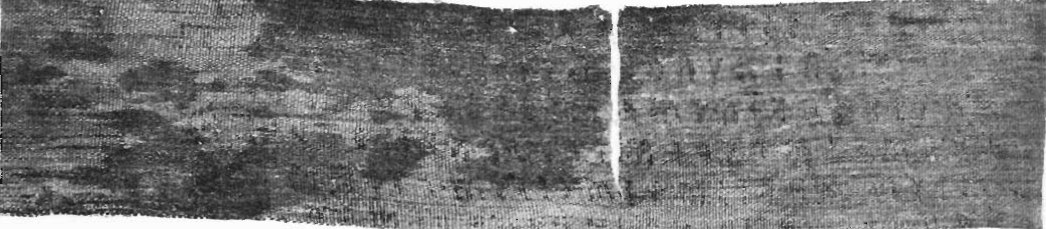
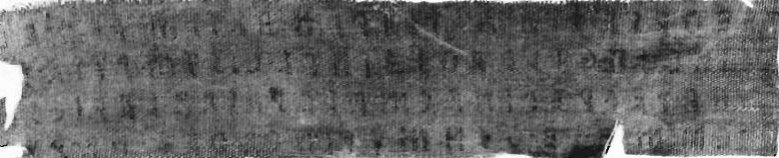
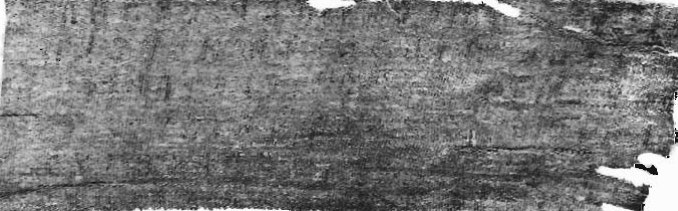
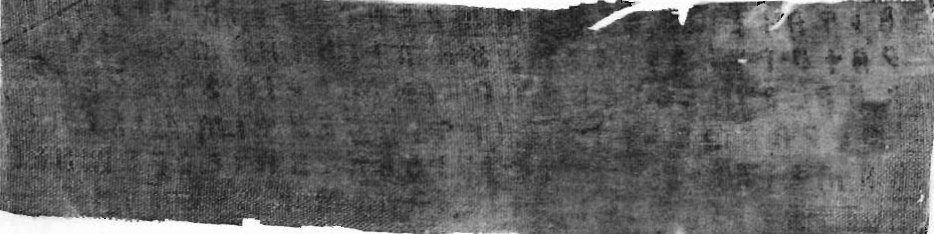
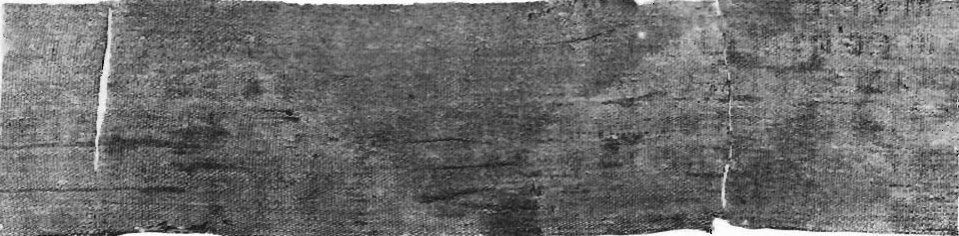

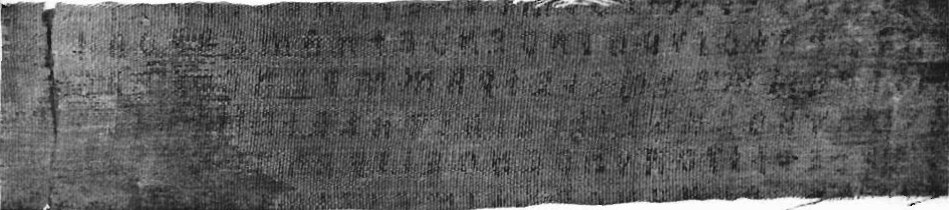
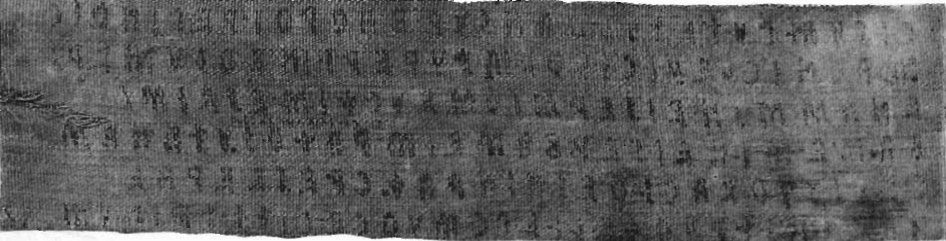
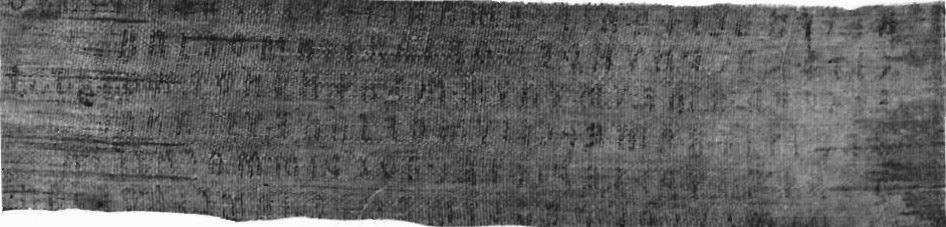

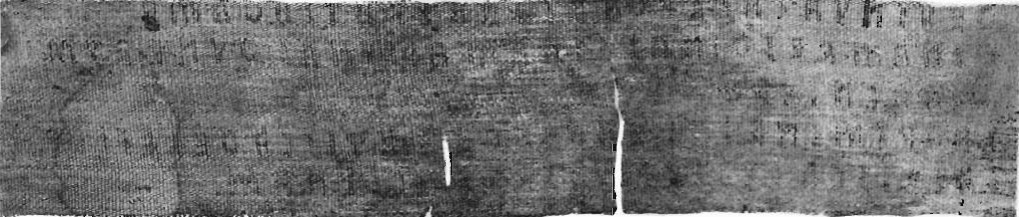
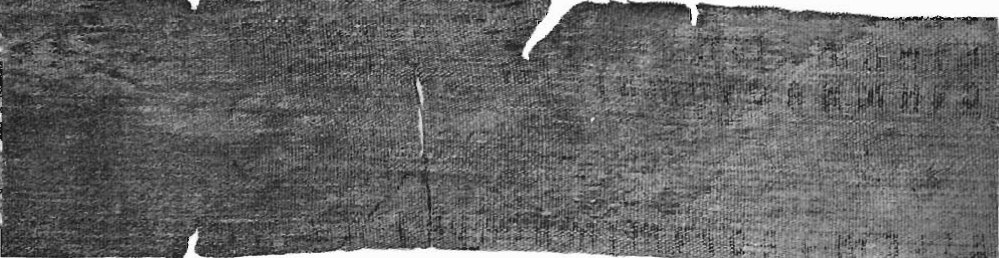
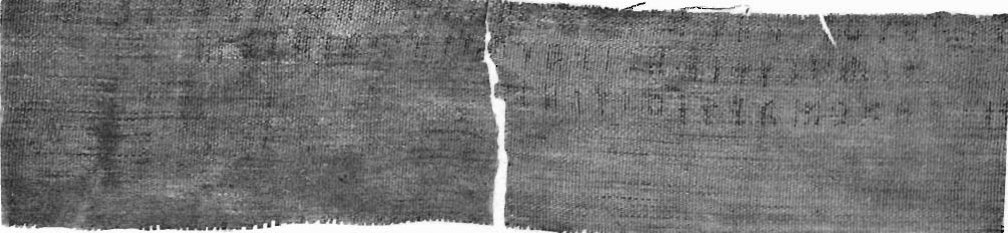
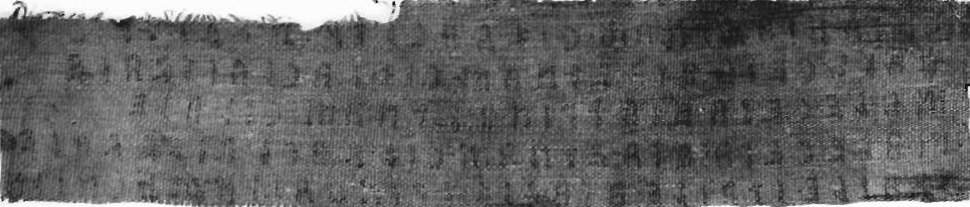
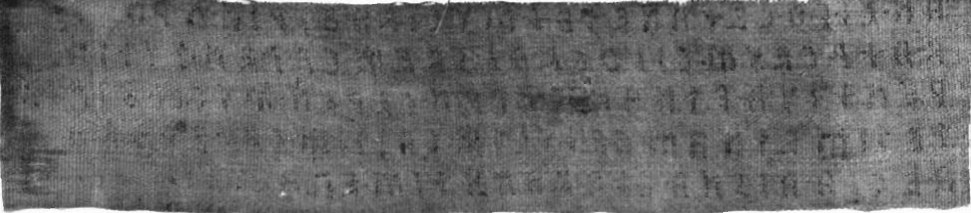
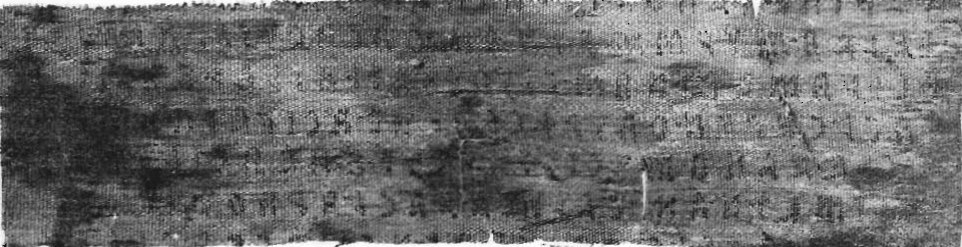
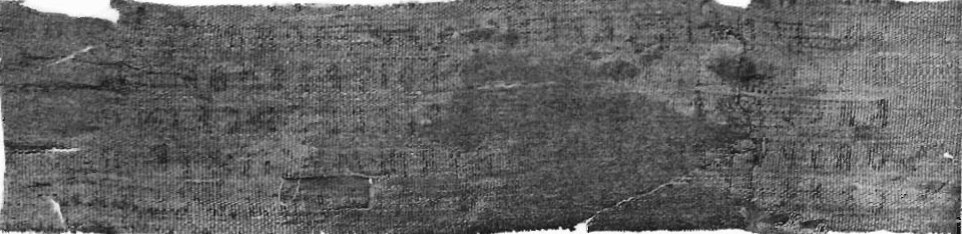

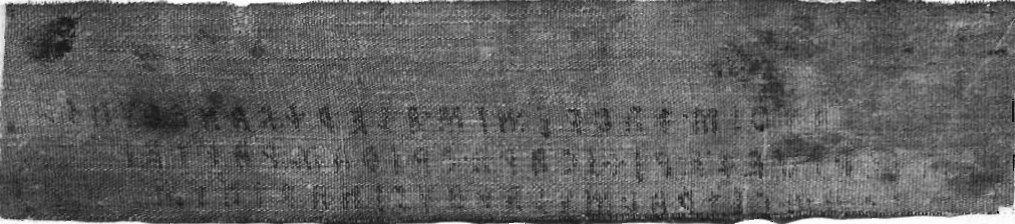
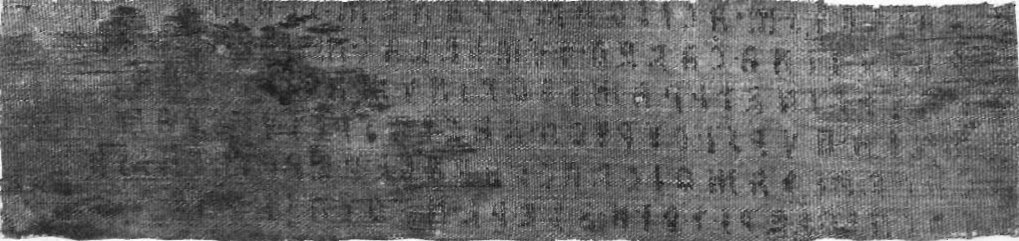
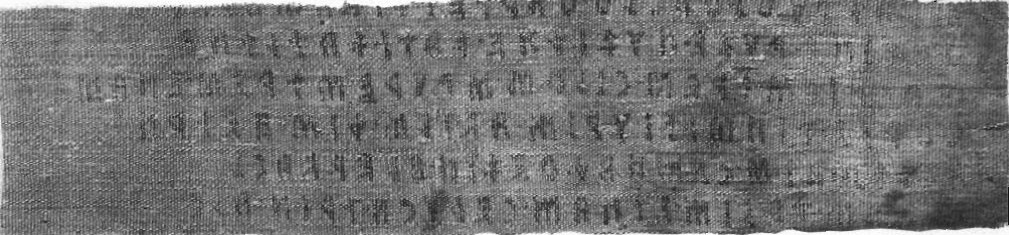
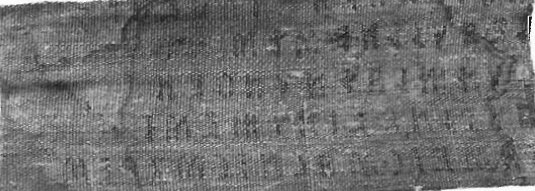

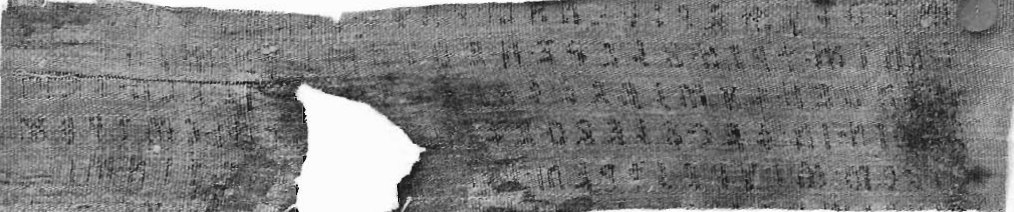
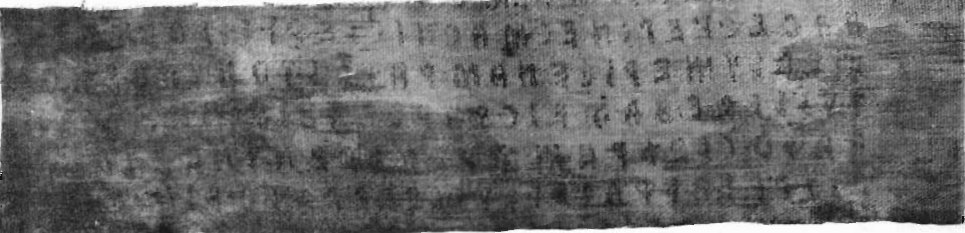
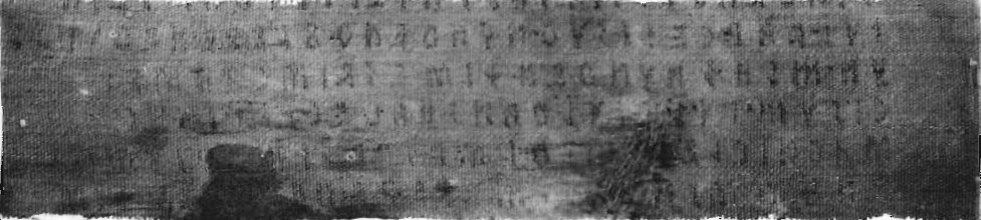
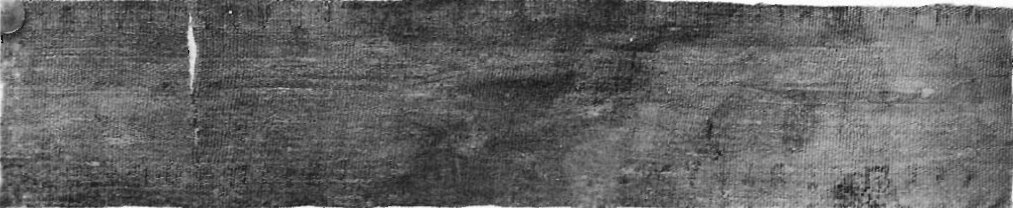
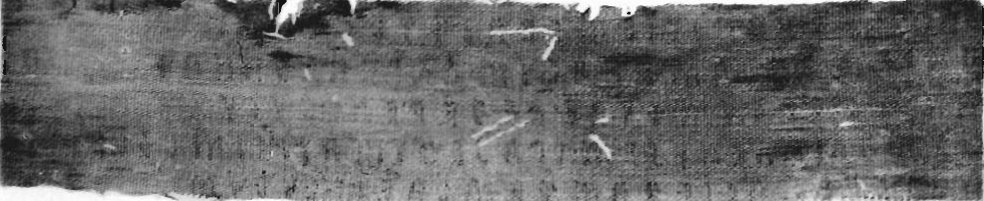
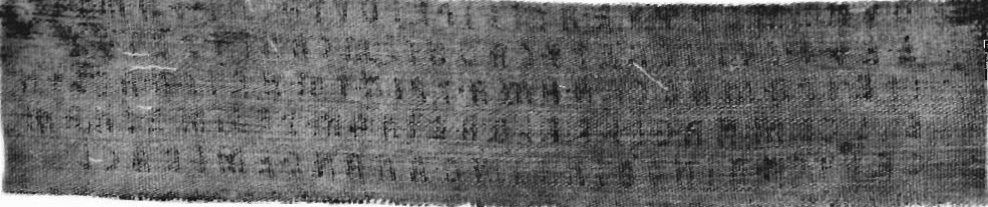
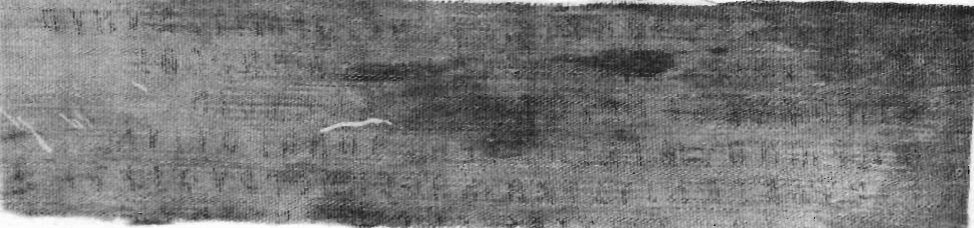
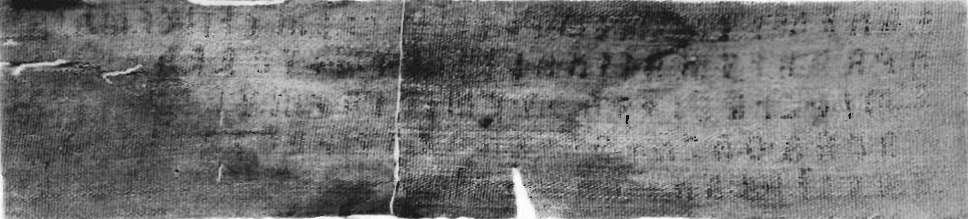
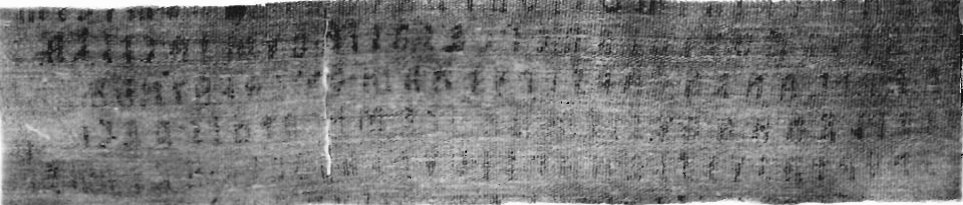
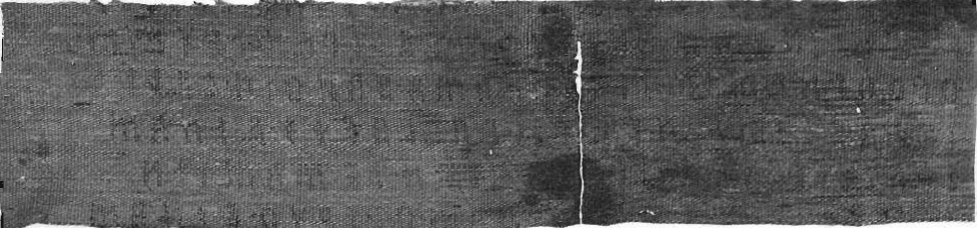
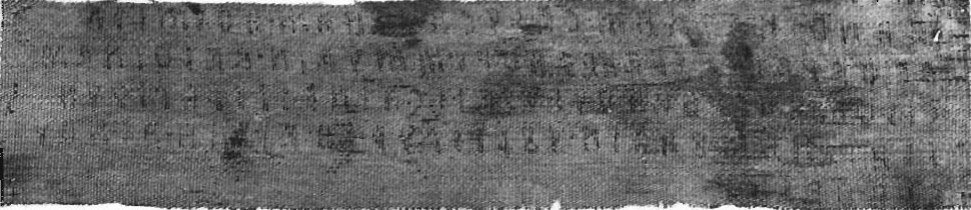
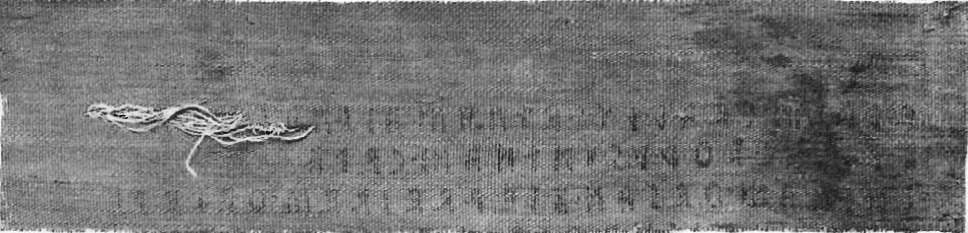
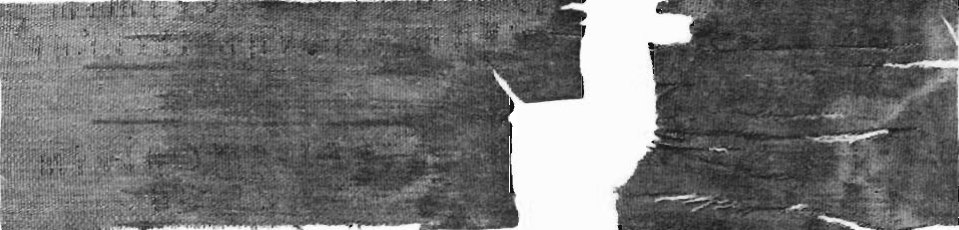
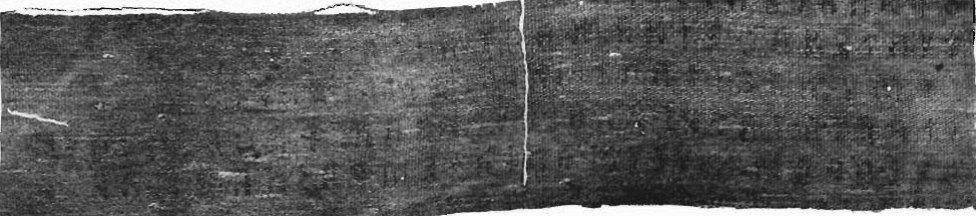
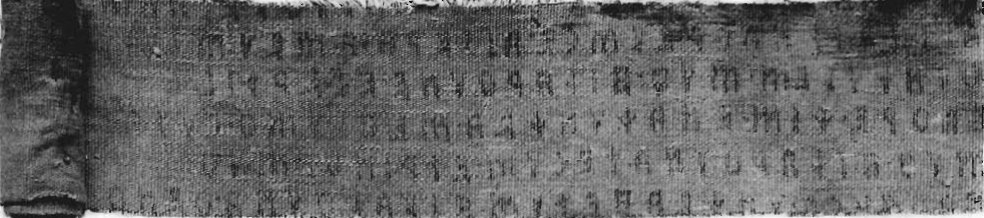

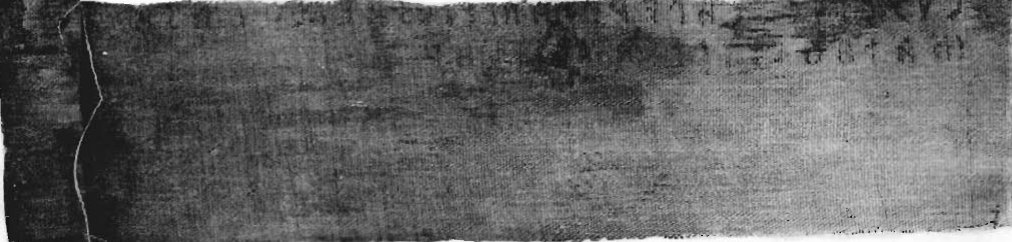
45 pieces of the linen book on 10 plates, all at one scale — J. Krall, 1892. His collotypes are a third smaller than the linen; these are smaller still.
An Etruscan book cut into bandages, an Egyptian woman, and a papyrus that may not be hers.
Every claim carries a tag for how well its sources support it.
Published sources only. Nothing here was checked against archives first-hand. A tag records how strongly the cited sources support a claim; it is never a verdict of our own dressed up as fact.
- 89 claims
- 29 sources
- 15 radiocarbon dates
- 7 gaps
- 21 leads
The markshow firmly the sources hold
The recordby when it happened
-
Established —
360 BC – AD 5:
Housley et al. 1989
The inscribed linen dates to 360 BC – AD 5
A single AMS sample from the book itself (OxA-1680, 2110 ± 60 BP). The authors stress that only this date, never the dates on plain bandages, can date the book.
-
Supported inference —
c. 360–210 BC:
Housley et al. 1989
Written in Etruria, most likely in the 3rd century BC
Housley and colleagues combine the book's own date with the date of mummification: the book cannot be older than its radiocarbon range, and must exist before the body was wrapped. The argument holds only if the book wrapped this body from the start.
-
Established —
at writing:
Housley et al. 1989 +1
A ritual calendar of more than 1,200 words, the longest Etruscan text known
The only surviving example of an Etruscan linen book.
-
Established —
at writing:
Housley et al. 1989 +1
Written in black and red: ivory black and cinnabar
Chemical analysis before dating found red and black paint containing mercury sulphide and charred ivory, so samples were cut from unpainted areas.
-
Claimed —
at writing:
van der Meer 2007 +1
Made near Lake Trasimeno, in south-eastern Tuscany
Argued from the local gods the calendar names.
Known here only through Wikipedia's summary of van der Meer.
-
Rejected —
1st c. BC or 1st c. AD:
Roncalli 1980 +1
Written in the 1st century BC or the 1st century AD
Two of the three dates proposed from the letter forms. Most researchers had also put the cutting into bandages in this window.
Rejected. The book wraps a body mummified about 385–210 BC, so it cannot be later than about 210 BC. This rests on Housley's two stated assumptions about the body sample. Housley et al. 1989
-
Rejected —
c. 390 BC → 3rd c. BC:
Case notes
The linen was about a century old when the book was written
Inferred in this case's own notes on 2026-11-11, by reading 2290 BP as the date of the book's cloth and setting it against the 2110 BP date of the inked sample.
Rejected. 2290 BP is a date on plain bandages, not on the book (Table 1). The book has one date of its own, and it fits a 3rd-century inscription. Housley et al. 1989
-
Rejected —
c. 390 BC ± 45:
Srdoč & Horvatinčić 1986 +2
Book and body both date to about 390 BC ± 45
The 1986 Zagreb conclusion, drawn from one date on plain bandages (2290 ± 45 BP). Still repeated by Uranić in 2006 and by the IMPACT database.
Rejected. The bandages are of at least two ages and carry no writing. In the authors' words, it is important not to use the high-precision dates on the wrappings to date the book. Housley et al. 1989
-
Unknown —
between writing and wrapping:
How the book reached Egypt
No evidence at all. Proposals include an Etruscan family living in Egypt, worn linen sold on as rags, or a traveller's possession.
-
Established —
at mummification:
Housley et al. 1989 +1
Cut into bandage strips to wrap a body in Egypt
Embalmers in this period often reused old cloth; this reuse is why the book survives at all.
-
Claimed —
at mummification:
Uranić 2006 +1
That body was this woman
Every source assumes it, but nobody recorded the unwrapping: when Barić died in 1859 she was already unwrapped and the bandages displayed apart. Her wrappings are of mixed ages, so some cloth was added later. The book's date is compatible with hers, which does not prove it.
-
Established —
c. 405–205 BC:
Housley et al. 1989 +1
Plain bandages, first group: about 405–205 BC
Three radiometric dates on uninscribed bandages, close to the body's age. The two high-precision dates disagree slightly, so even this group is not one cloth.
-
Established —
c. 1015–800 BC:
Housley et al. 1989
Plain bandages, second group: about 1015–800 BC
Two AMS dates on one piece of uninscribed linen, some six centuries older than the body.
-
Established —
at death:
Plavšić 1986 · Uranić 2006
A woman aged 30–40, 164 cm tall, mummified the Egyptian way
Established by X-ray in 1986. Teeth and nails are intact. The 1998 restorer judged the embalming typical of late dynastic Egypt.
-
Established —
395–40 BC:
Housley et al. 1989
Her tissue dates to 395–40 BC
OxA-1386, 2160 ± 80 BP. The authors write that the body had been soaked in kerosene in the 19th century, and cleaned the sample first. This is probably the petroleum bath the museum gave her around 1900.
-
Supported inference —
c. 385–210 BC:
Housley et al. 1989
Mummified about 385–210 BC, at the end of the Late Period or early in Ptolemaic rule
The pooled mean of the tissue and the plant part of the unguent is 2218 ± 12 BP. This assumes the kerosene was fully removed and the plants were fresh when used.
-
Established —
at mummification:
Housley et al. 1989
Her embalming unguent contains fossil carbon
The unguent's plant part dates with the body, but a small soluble fraction gives 1430–1020 BC and a melted fraction 3610–2920 BC. The authors suggest bitumen or fossil resin, possibly from Sinai.
-
Unknown —
at death:
Housley et al. 1989 +2
Who she was
Two explanations circulate. Neither has direct evidence.
- Hypothesis 1. An Egyptian woman. The book was old linen reused by the embalmers, which was customary in this period. Housley et al. 1989 · Wikipedia
- Hypothesis 2. A woman of Etruscan descent living in Egypt, buried the Egyptian way with an Etruscan sacred book. Offered by the museum's curator as one possible explanation. Uranić 2006
-
Established —
c. 1400–520 BC:
Housley et al. 1989
The wreath's leaves are centuries older than the body
Zagreb first blamed counting statistics; Groningen and Oxford confirmed the older age independently.
-
Established —
at burial:
Tvrtković 1986 +2
A wreath of sewn leaves holding the skull of a young cat, with flowers and a necklace
Some leaves look stained, probably with an organic dye; X-ray fluorescence found no lead, mercury or iron paint.
-
Claimed —
at burial:
IMPACT database
Bird bones and a mummified crocodile among the wreath
Reported by IMPACT from an unpublished overview. Not mentioned by Uranić.
-
Established —
end of Late Period / early Ptolemaic:
Uranić 2006
Papyrus Zagreb 602 names Perekh-Khons, servant of Khnum, and his wife Nesi-Khons
A Book of the Dead in hieratic. The vignette shows a man and a woman praising Osiris and Imenty. His titles include god's servant in the temple of Karnak; she is mistress of the house. The text dates to the end of the Late Period or the start of Ptolemaic rule.
-
Contested —
end of Late Period / early Ptolemaic:
IMPACT database +2
Her husband was a 'divine tailor' of Thebes
The popular version names them Nesi-hensu and Paher-hensu, which are spellings of the same names. Only the title differs: the curator's published reading of the vignette has him as servant of Khnum, with no tailor.
- Version 1. Nesi-hensu, wife of Paher-hensu, a Theban 'divine tailor'. IMPACT database · Wikipedia
- Version 2. Nesi-Khons, mistress of the house, wife of Perekh-Khons, servant of Khnum and god's servant in Karnak. Uranić 2006
-
Contested —
at burial:
Ilija Barić's papers +2
The mummy is Nesi-Khons
First asserted by her owner's brother in 1862, to prove she was genuine. The curator calls the link only an assumption, 'because it cannot be proved', and nothing else in the remains points to her.
- Version 1. The papyrus's date generally fits the radiocarbon date of the mummy. Uranić 2006
- Version 2. The papyrus is at least a century younger than the mummy, on linguistic grounds. Liber i mumija 2019
-
Supported inference —
at burial:
Uranić 2006
Buried in Upper Egypt, probably near Thebes
Follows from the husband's Karnak title, and holds only if the papyrus belongs to this mummy.
-
Unknown —
undated:
The tomb
No findspot, excavation, tomb or village is recorded for any of the objects.
-
Unknown —
between burial and sale:
Housley et al. 1989
How materials of different ages came together
That they did is measured (bandages and leaves centuries older than the body). Who combined them, and when, is not known. Two mechanisms are proposed, with no evidence that picks one.
- Hypothesis 1. Ancient: embalmers of this period are known to have reused old materials. Housley et al. 1989
- Hypothesis 2. Modern: 19th-century repair, or tomb robbers rewrapping a damaged mummy with cloth from other tombs, before the sale. Housley et al. 1989
-
Established —
c. 1791–1850:
Mirnik & Rendić-Miočević 1986 +1
Michael Barić: born in Semeljci, Slavonia, about 1791; studied theology, never ordained
Around 1850 he parcelled out land he owned in Vienna's 3rd district, where Barichgasse still bears his name. He kept an art collection.
-
Established —
1829–1848:
Wiener Zeitung 1829 +2
Barić is a court official: Hofkonzipist of the Royal Hungarian Court Chancellery, pensioned at his own request in 1848
Appointed in 1829 (Wiener Zeitung). Krall adds a six-year lease of the Pressburger Deutsche Zeitung from 1843.
-
Unknown —
1848–49:
Uranić 2006
Sold by an unknown merchant
The museum's own curator calls the seller 'an unknown merchant'. This is the central missing link.
-
Established —
1848–49:
Uranić 2006 +2
Mihael Barić, a Croat living in Vienna, acquires the mummy
Every source agrees, and his heirs later gave her to the museum. No purchase document is cited anywhere.
-
Supported inference —
1848–49:
Uranić 2006 +2
He bought her in Egypt, on a journey there in 1848–49
The journey and its date rest on one witness: Barić's niece, telling Krall in the early 1890s. Uranić states the purchase plainly, then calls it 'almost certain'. The hedge is kept.
-
Claimed —
1848–49:
Wikipedia +1
In Alexandria
Popular accounts name Alexandria. The curator says only Egypt.
-
Unknown —
1848–49:
Krall 1892
The journey: route, dates, companions
Known only from the niece's recollection. Routes, dates and companions are unrecorded. His 1849 file, his probate file and the niece herself are the ways in.
-
Claimed —
1848–49:
Mirnik & Rendić-Miočević 1986
She was still fully wrapped when he bought her
The 1986 editors say so but mark it as their own conjecture.
-
Unknown —
1849:
Export from Egypt and shipment to Vienna
Egypt had banned the export of antiquities in 1835, with loose enforcement. No permit, manifest or shipping record is known.
-
Established —
1849:
Krall 1892 +1
Back from Egypt, he applies to re-enter service and is refused
File Z. 23726/1849 of the Ministry of the Interior. Krall placed it in the Hungarian national archives; the 1986 editors in the state archive in Vienna.
Where the file is today is contested between the two sources and unverified.
-
Established —
1849–1859:
Uranić 2006 +2
Kept at Barić's home in Vienna
She stood in his art collection. His last address, Altenfleischmarkt 728, is today Rotenturmstrasse 20; the building has been replaced.
-
Established —
1849–1859:
Ilija Barić's papers +1
Displayed naked and fully upright on an iron rod, in a tall glass case hung with curtains
The bandages and papyri lay in a second, horizontal glass case. The 'corner of his sitting room' of popular accounts is not in the documents.
-
Established —
by 1859:
Uranić 2006 +2
Unwrapped, with the bandages displayed separately
By Barić's death in 1859 she was unwrapped and the bandages shown apart. Krall could not find out when: his informants disagreed, and the niece remembered seeing her bare face before 1859. Nobody recorded what lay where.
-
Claimed —
1849–1859:
Ancient Origins +2
Barić unwrapped her himself and put the bandages in a glass case
Popular accounts. The curator and IMPACT say only that she was found unwrapped at his death.
-
Established —
14 Dec 1859:
Wiener Zeitung 1859 +2
Michael v. Barić dies in Vienna, aged 68
Death list: 'pens. königl. ung. Hofkonzipist, 68 J., Altenfleischmarkt 728, Erschöpfung der Kräfte'.
-
Established —
1859:
Mirnik & Rendić-Miočević 1986 +1
His will leaves everything to his niece, Th. Jellinek, and names his brother Ilija executor
-
Rejected —
1859:
Ancient Origins
Ilija had no interest in the mummy and simply gave it away
Ilija was in fact a dean, consistorial councillor and parish priest at Golubinci.
Rejected. He wrote the formal declaration and a detailed letter to the Ban, argued her authenticity, and steered the transfer. The gift followed Michael's will. Ilija Barić's papers · Mirnik & Rendić-Miočević 1986
-
Rejected —
1859:
Wikipedia
Brugsch examined mummy and bandages in 1859 and took the writing for hieroglyphs
Rejected. Brugsch saw the bandages in Zagreb in 1869, saw the script was alphabetic, and could not name it. Mirnik & Rendić-Miočević 1986 · Uranić 2006 · Krall 1892
-
Established —
14 Dec 1861:
Ilija Barić's papers +1
Ilija declares the gift, as Michael's will directed
Written on the second anniversary of the death: the mummy goes to the planned South Slavic Academy, or failing that to the National Museum, in his brother's name. The 1986 editors think the museum choice was probably Ilija's suggestion.
-
Established —
5 Aug 1862:
Sabljar's receipt and label +2
Received by the National Museum on 5 August 1862, in her two glass cases
The Vienna display furniture travelled with her, body and bandages already apart. She was housed in the former Drašković palace in Opatička street.
-
Established —
19 Mar 1862:
Ilija Barić's papers +2
Ilija describes her to the Ban, and says the 'palm leaves' prove she is genuine
A young woman with all her teeth, nails and hair, a golden boss on her forehead, and at her side '4–5 fascicles of palm leaves, full of inscriptions and figures'. The palm leaves are the papyri; the papyrus–mummy link starts here, as an heir's argument.
-
Established —
1862:
Sabljar's receipt and label +2
Curator Mijat Sabljar logs the bandages as written with 'Egyptian letters'
His label in the vitrine credited the donor: 'Mumia iz Misira (Aegypten). Poklonio gosp. Ilia Barić'.
-
Contested —
May 1862:
Mirnik & Rendić-Miočević 1986
The Academy's committee, chaired by Ambroz Vraniczany, accepts the gift 'with great joy'
The printed edition disagrees with itself about the dates. Only the manuscript (Arhiv Hrvatske 462*1862) can settle them.
- Version 1. Meeting 7 March, reply 13 May (the 1986 narrative, p. 43). Mirnik & Rendić-Miočević 1986
- Version 2. Meeting 7 May, letter closed 18 May (document IV, p. 54). Mirnik & Rendić-Miočević 1986
-
Established —
Jul 1862:
Mirnik & Rendić-Miočević 1986
Officials inspect the Vienna apartment, and an expert packer prescribes three crates
Ivan Mažuranić of the court chancellery reports on 19 July that the inspection 'matches Ilija's description almost completely'. One crate for the mummy alone, one for the empty case, one for bandages and the second case. The vice-regal council approves on 22 July.
The packer's institution is uncertain in the OCR; it may read as the Ambras collection.
-
Established —
Jul 1862:
Mirnik & Rendić-Miočević 1986
By rail to Zidani Most, then by carriage with an escort to Zagreb
The Vienna accounts: crates 45 fl, removal and rail 25 fl 70 kr, telegram 4 fl 20 kr, stated total 75 fl 20 kr. The items sum to 74 fl 90 kr; the 30 kr gap is reported, not repaired. The Zagreb leg cost 10 fl 48 kr, and the file closed on 4 September 1862 with 14 fl 32 kr returned.
-
Supported inference —
22–25 Jul 1862:
Mirnik & Rendić-Miočević 1986
She physically reached Zagreb between 22 and 25 July 1862
Proposed by the 1986 editors. The 25 July accounts only reach Zidani Most, so they do not pin the Zagreb end. Arrival first and formal receipt on 5 August is a possible reading, not an established sequence.
-
Established —
19 Mar 1862:
Ilija Barić's papers +1
Ilija's inventory: a golden boss on her forehead and '4–5 fascicles' of papyrus
He places the boss 'where the brain was probably extracted'. This establishes what he described, not that it was ancient or still with her.
-
Rejected —
1862–1891:
Sabljar's receipt and label +1
The writing on the bandages is Egyptian
The working assumption for three decades.
Rejected. Krall identified the language as Etruscan. Krall 1892 · Uranić 2006
-
Established —
1862 – today:
Uranić 2006 +1
Held by the Archaeological Museum in Zagreb
Then the National Museum. Everything is there today, though not necessarily everything that arrived (G7).
-
Unknown —
1862 – today:
Ilija Barić's papers +1
What arrived in 1862, and what is there now
No modern account mentions a gold object, and the known papyri are Zagreb 602 with Book of the Dead fragments, not obviously four or five fascicles. Meanwhile a glass-paste bead necklace and wreath fragments were first shown in 1986 with no 1862 mention. Differences in description do not yet prove loss or substitution.
-
Contested —
Mar 1863:
Mirnik & Rendić-Miočević 1987 +1
The receipt is written up in March 1863
Both versions give the same 5 August arrival. They may be two records or an editorial difference; the manuscripts are unchecked.
- Version 1. Receipt note dated 10 March 1863. Mirnik & Rendić-Miočević 1987
- Version 2. Gift register AAMZ 23, 'Opis darovah 1855–64', entry dated 2 March 1863. Šolter 2016
-
Rejected —
1867, 1868 or 1885:
Wikipedia +2
She came to the museum in 1867, 1868 or 1885
1867 is Wikipedia's year, 1868 National Geographic's, 1885 the unexplained 'date of acquisition' in the IMPACT header. 1868 is when the museum bought Franz Koller's Egyptian collection in Prague, a likely source of the confusion.
Rejected. The museum's receipt records her arrival on 5 August 1862, and the transfer file closed in September 1862. Sabljar's receipt and label · Mirnik & Rendić-Miočević 1987 · Mirnik & Rendić-Miočević 1986
-
Established —
1869:
Mirnik & Rendić-Miočević 1986 +2
Heinrich Brugsch finds writing on a folded-back edge, combs through 40 metres of linen, and cannot name the script
Invited by the new curator Šime Ljubić to arrange the Egyptian collection, he saw the script was alphabetic and copied it, then told Krall only in 1891, by letter.
One 1892 newspaper (Grazer Tagblatt) gives 1868.
-
Established —
1870 and 1889:
Mirnik & Rendić-Miočević 1986
Ljubić catalogues the mummy and bandages first in the Egyptian collection
1870 in the museum's Viestnik; 1889 in his printed catalogue, with two pages and a plate.
-
Established —
1872:
Mirnik & Rendić-Miočević 1986 +1
A request to lend the book to the Leipzig congress of philologists is refused
Asked on the strength of Brugsch's report. Museum and government both said no.
-
Claimed —
1877:
Wikipedia
A talk with Richard Burton about runes convinces Brugsch the script is not Egyptian
Only Wikipedia tells this story. The 1986 account, after Krall, has Burton seeing the bandages himself in Zagreb in 1877.
-
Established —
1877:
Mirnik & Rendić-Miočević 1986 +1
Richard Burton sees the bandages himself, on a visit to Zagreb
-
Established —
1879:
Burton 1879 +2
Burton publishes the text as runic, in 'The Ogham-Runes and el-Mushajjar'
From a copy made in 1878 by his vice-consul in Trieste, Philip Proby Cautley.
-
Contested —
1880 or 1882:
Bojničić, Kroatische Revue +3
A catalogue entry calls the bandages 'an unknown Egyptian script' and one of the museum's foremost treasures
By I. v. Bojničić in the Kroatische Revue. It is the entry that later caught Krall's eye, and the ancestor of most later retellings.
- Version 1. 1880, first issue. Krall 1892
- Version 2. 1882, vol. 3, p. 130. Mirnik & Rendić-Miočević 1986
-
Claimed —
1890–92:
Kršnjavi, Zapisci +1
Iso Kršnjavi informs Emperor Franz Joseph I of the discovery
The 1986 footnote prints the date as '17. I. 1890', before the bandages even reached Krall. The date as printed cannot be right.
-
Established —
1891:
Uranić 2006
Brugsch writes to Jakob Krall about 'an interesting monument in Zagreb'
-
Established —
1891–92:
Krall 1892 · Uranić 2006
The bandages reach the Vienna University Library on 31 January 1891, on loan for about a year
-
Established —
1891–92:
Krall 1892 +2
Jakob Krall identifies the language as Etruscan
He first saw the bandages on 3 February 1891 and drafted the finding for Deecke and Pauli that August. His 1892 monograph brought in J. M. Eder's orthochromatic photographs, J. Wiesner's analysis of linen and ink, and V. von Ebner's study of her hair.
-
Established —
Jan 1892:
Vienna and Graz press, Jan 1892 +1
The discovery reaches the newspapers
The Vienna and Graz reports share their wording, so they count as one witness. Krall also wrote it up himself in the Agramer Zeitung, no. 67/1892, which is not yet found.
-
Contested —
1892 or c. 1900:
Šolter 2016 +1
The upright display ends and she is laid horizontal
Photographs pin her still upright in 1890–91. The two accounts may describe two episodes; they are not merged.
- Version 1. 1892, by Šime Ljubić with the physician Antun Lobmayer (photo caption). Šolter 2016
- Version 2. Around 1900, after the petroleum bath weakened her joints. Mirnik & Rendić-Miočević 1986
-
Established —
1892 – today:
Uranić 2006 +3
No accepted translation
A century of readings, from Lattes and Pallottino to Olzscha, then the editions of van der Meer (2007) and Belfiore (2010). A 2014 review judged a newer full translation less coherent than the ones before it.
-
Established —
c. 1900:
Mirnik & Rendić-Miočević 1986 +1
Bookworms attack her legs, and the museum kills them with a long petroleum bath
The worms died, but her joints were weakened. This is very likely the kerosene the 1989 laboratory had to wash out of its tissue sample.
-
Established —
1910:
Mirnik & Rendić-Miočević 1986
Gustav Herbig finds one more inscribed piece among the leftover bandages
The 'new' or Herbig fragment, from the book's beginning. The museum's director Josip Brunšmid then glues all the strips to coarse gauze, a mounting undone in 1985.
-
Established —
1913–14:
Mirnik & Rendić-Miočević 1986
In Rostock, Rudolf Kobert cleans the Herbig fragment, and the rest of the plan dies with the war
Working unpaid, Kobert found the dark stains carry iron salts, 'probably from decomposed blood', eating the fabric. The museum then valued the strips at one million crowns and kept the inscribed ones in its treasury. Herbig thought cleaning could recover about a quarter of the text; the last letter is answered on 6 January 1914.
-
Established —
1932–35:
Mirnik & Rendić-Miočević 1986
Ivan Plotnikov's infrared photographs make stained passages readable
90 of the 245 lines were photographed, and published by Runes and Cortsen in 1935.
-
Established —
Jul 1940:
Mirnik & Rendić-Miočević 1986
Emil Vetter offers free infrared photography in Vienna, and the museum declines for now
Hoffiller's reply is procedural, not hostile, and notes Pallottino also wants images, but 'now is just not the right time to travel the world with such monuments'.
-
Established —
1952:
Mirnik & Rendić-Miočević 1986
The 1861–62 transfer documents turn up among Bishop Strossmayer's papers
Found by V. Košćak and excerpted in the newspaper Vjesnik on 21 June 1962.
-
Established —
1966–67:
Mirnik & Rendić-Miočević 1986
The whole book is photographed in infrared at the police criminological institute
Ivan Lukan took 86 photographs under curator Vera Vejvoda; Ramiza Pfleger made a linen facsimile from them. They were first reproduced in full in 1986.
-
Claimed —
1967:
IMPACT database
Put on permanent display, later sealed in a climate-controlled case after visitors' hands damaged her
-
Established —
Dec 1984:
Mirnik & Rendić-Miočević 1986
Nazzareno Gabrielli finds the body desiccated and 'slowly turning to dust'
Without treatment her skeleton would be exposed within decades. His restoration followed in 1998.
-
Established —
Jan–Apr 1985:
Uranić 2006 +1
Restored at the Abegg-Stiftung by Mechtild Flury-Lemberg and remounted as shown today
Reconstruction supervised by Francesco Roncalli. The Centraal Laboratorium in Amsterdam analysed the inks and the 1910 glue; glue and gauze were removed.
-
Established —
1985–86:
Mirnik & Rendić-Miočević 1986
Shown in Perugia (Scrivere etrusco, 1985) and Zagreb (Pisati etruščanski, 1986)
In Zagreb the hospital X-rays, a necklace of coloured glass-paste beads and fragments of the leaf wreath were shown in public for the first time.
-
Established —
1986:
Mirnik & Rendić-Miočević 1986 +3
The museum's 1986 volume prints the transfer documents, X-rays, radiocarbon and the cat skull
-
Established —
1988–89:
Housley et al. 1989
Three laboratories show the mummy is an assemblage of different ages
Fifteen dates across book, body, bandages, leaves and unguent, spanning more than a thousand years.
-
Established —
1998:
Uranić 2006 +1
The body is restored by Nazzareno Gabrielli of the Vatican Museums
-
Established —
2006:
Uranić 2006
The curator publishes the papyrus and finds no proof it belongs to her
-
Claimed —
2019:
Liber i mumija 2019
The museum's volume Liber i mumija dates the papyrus a century after the mummy
Known only through a search summary. Not read.
Two scalesKrall, 1892
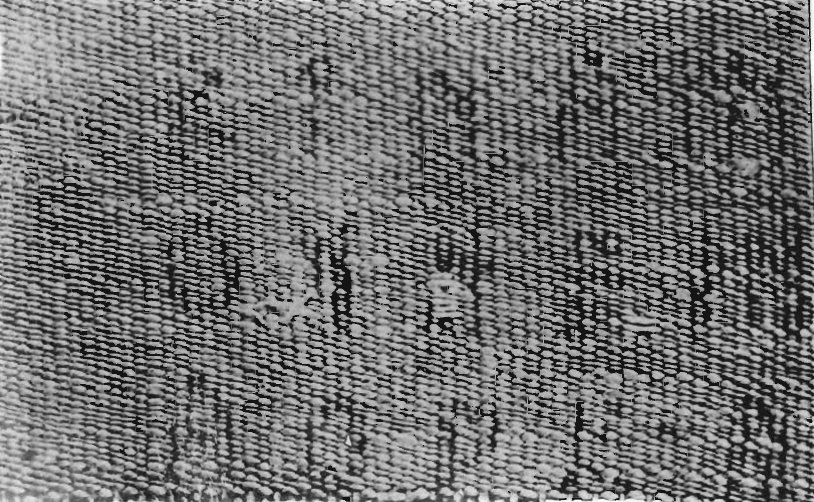
Betrachtet man dagegen die Buchstaben mit einem Verkleinerungsglase, so treten sie schärfer hervor, indem die schwarzen Pünktchen, aus denen sie bestehen, mehr aneinanderrücken.
Enlarging the signs does not improve the chances of reading them. Seen through a reducing glass, the letters stand out more sharply, as the black dots they are made of move closer together. This benefits the collotypes, which are a third smaller than the original.
Krall 1892, § 9, p. 21The datesradiocarbon, as calibrated in 1989
| lab | object | material | BP | calibrated, 2σ |
|---|---|---|---|---|
| OxA-1680 | Book | Liber linteus (inscribed linen) | 2110 ± 60 | 360 BC – AD 5 |
| OxA-1386 | Body | Human tissue | 2160 ± 80 | 395–40 BC |
| Body had been soaked in kerosene in the 19th century; washed before dating. | ||||
| Z-1653 | Bandages | Linen wrappings | 2290 ± 40 | 405–210 BC |
| The 1986 Zagreb date later used, wrongly, to date the book. | ||||
| GrN-13875 | Bandages | Linen wrappings | 2210 ± 13 | 365–205 BC |
| GrN-14442 | Bandages | Linen wrappings | 2335 ± 15 | 405–395 BC |
| OxA-1387 | Bandages | Linen wrappings | 2760 ± 90 | 1015–800 BC (with OxA-1388) |
| Oxford cellulose pretreatment. | ||||
| OxA-1388 | Bandages | Linen wrappings (same piece) | 2700 ± 90 | 1015–800 BC (with OxA-1387) |
| Zagreb pretreatment. | ||||
| Z-1654 | Wreath | Leaves | 2580 ± 60 | 900–520 BC |
| Measured on a less reliable sample after the clean leaves were lost in a laboratory accident. | ||||
| GrN-14467 | Wreath | Leaves | 2825 ± 15 | 1015–925 BC |
| OxA-1389 | Wreath | Leaves | 2920 ± 100 | 1400–905 BC |
| GrN-13860 | Body | Embalming unguent | 2240 ± 13 | 385–255 BC |
| Z-1682 | Body | Unguent, fraction insoluble in chloroform | 2230 ± 50 | 395–190 BC |
| OxA-1390 | Body | Unguent, fraction insoluble in chloroform | 2160 ± 100 | 400 BC – AD 40 |
| OxA-1391 | Body | Unguent, fraction soluble in chloroform | 3010 ± 80 | 1430–1020 BC |
| Old carbon: probably bitumen or fossil resin. | ||||
| Z-1675 | Body | Unguent, melted and exuded fraction | 4540 ± 120 | 3610–2920 BC |
| Old carbon: probably bitumen or fossil resin. | ||||
Laboratories: Z = Ruđer Bošković Institute, Zagreb; GrN = Centre for Isotope Research, Groningen; OxA = Radiocarbon Accelerator Unit, Oxford. Ranges are 2σ (95.4%) as calibrated in 1989 and have not been recalibrated against current curves.
The gapswhat no source records
- G1
The seller
Who sold the mummy in 1848–49. Even the museum calls him an unknown merchant.
trail A, ownershipin the record — Sold by an unknown merchant
- G2
The tomb
Where she was buried and how she left the ground. The Theban guess rests on a papyrus that may not be hers.
trail A, ownershipin the record — The tomb
- G3
The crossing
How an Etruscan sacred book reached an Egyptian embalming workshop. Probably unanswerable without G2.
trail C, ancientin the record — How the book reached Egypt
- G4
What belongs together
The unwrapping happened at an unknown time and was never documented. The bandages and leaves are of different ages, and the papyrus link is an heir's argument. Which objects were really found with which is open.
trail C, ancientin the record — That body was this woman, The mummy is Nesi-Khons, How materials of different ages came together, Unwrapped, with the bandages displayed separately
- G5
The export
How a mummy left Egypt in 1849 under an export ban, and how it reached Vienna.
trail A, ownershipin the record — Export from Egypt and shipment to Vienna
- G6
The journey
Barić's route, dates and companions in 1848–49, known only from his niece's recollection. Ways in: file Z. 23726/1849, the probate file, the niece.
trail A, ownershipin the record — The journey: route, dates, companions
- G7
Inventory drift
Ilija's 1862 description lists a golden forehead boss and four or five papyrus fascicles; modern accounts know no gold object, and add a bead necklace and wreath fragments first shown in 1986. What arrived, what was recorded, what remains?
trail A, ownershipin the record — What arrived in 1862, and what is there now
The leadswhere a record may be
- L1
Agramer Zeitung, July–August 1862 and no. 67/1892open
Zagreb's own coverage of the arrival, and Krall's own article. ANNO does not hold either year.
National and University Library (NSK), Zagreb, on paper or microfilm. The NSK digital catalogue finds no 1862 issues.
access — library requestdigitalna.nsk.hr ↗would settle — She physically reached Zagreb between 22 and 25 July 1862, The discovery reaches the newspapers
- L2
Barić's will and probate file, Vienna 1859open
The will directed the gift. It may describe the mummy, the purchase, or papers that came with her.
Vienna probate records, probably the Wiener Stadt- und Landesarchiv. Not yet confirmed.
access — archive requestwould settle — G1, The seller, G4, What belongs together, G6, The journey
- L3
File Z. 23726/1849open
Barić's 1849 application could date the journey and say where he went.
Hungarian national archives (Krall) or the state archive in Vienna (1986). Shelfmark unknown.
access — archive requestwould settle — G6, The journey, Back from Egypt, he applies to re-enter service and is refused
- L4
Find Th. Jellinekopen
The niece and principal heir, and the source of the 1848–49 date. Her estate may hold Barić's papers.
Lehmann's Vienna address books of the 1890s; estate records.
access — partly onlinewould settle — G6, The journey, The journey: route, dates, companions
- L5
The Kroatische Revue entry, 1880 or 1882open
The wording-ancestor of most later retellings. Settles its own year.
Kroatische Revue, Zagreb.
access — librarywould settle — A catalogue entry calls the bandages 'an unknown Egyptian script' and one of the museum's foremost treasures
- L6
Abegg-Stiftung and Amsterdam records, 1985open
Residues on the strips could show whether the book ever touched this body's unguent, and whether Kobert's 1913 chemicals are still on the Herbig fragment.
Abegg-Stiftung, Riggisberg; Centraal Laboratorium, Amsterdam.
access — requestwould settle — G4, What belongs together, That body was this woman
- L7
Herbig 1911, p. 6open
A garbled footnote seems to list wood, painted fragments and a small mummified animal among the wreath remains.
Herbig's 1911 publication on the text.
access — librarywould settle — G7, Inventory drift
- L8
Read Liber i mumija (2019)open
Check the claim that the papyrus is a century younger than the mummy, and how it is argued.
Archaeological Museum in Zagreb, 2019.
access — library or museumwould settle — G4, What belongs together, The mummy is Nesi-Khons
- L9
Read Krall 1892 beyond the introductionpartly
The introduction yielded the niece, the 1849 file and the 1891 dates. The rest may hold more.
Salomon Reinach project PDF; HathiTrust.
access — public domaintpsalomonreinach.mom.fr ↗would settle — G4, What belongs together, Unwrapped, with the bandages displayed separately
- L10
Read Burton 1879 in fullpartly
Whether Burton's own text mentions a conversation with Brugsch.
Transactions of the Royal Society of Literature, vol. 12.
access — public domainwould settle — A talk with Richard Burton about runes convinces Brugsch the script is not Egyptian
- L11
Vienna newspapers, summer 1862partly
Die Presse and Wiener Zeitung for 22–31 July and 5–8 August 1862 were screened with nothing found. 1–4 August and later August remain.
ANNO
access — free, full textanno.onb.ac.at ↗would settle — She physically reached Zagreb between 22 and 25 July 1862
- L12
Trace the 'divine tailor' titleopen
Find where it comes from: an older reading, a museum label, or a mistake copied forward.
Older museum guides, early press, IMPACT's unpublished source.
access — mixedwould settle — Her husband was a 'divine tailor' of Thebes
- L13
Find Perekh-Khons and Nesi-Khons elsewhereopen
Uranić notes a Nesi-Khons, prophetess of Hathor, on a statue pedestal in the British Museum. Other monuments could point to a family tomb at Thebes.
Topographical Bibliography (Porter & Moss) vol. VIII, no. 801-768-140; British Museum collection search.
access — partly onlinewould settle — G2, The tomb, The mummy is Nesi-Khons
- L14
Danielsson's papers, Uppsalaopen
The editor of the Etruscan corpus was consulted in December 1913; the Rostock plan may survive in his correspondence.
Uppsala University Library.
access — archive requestwould settle — In Rostock, Rudolf Kobert cleans the Herbig fragment, and the rest of the plan dies with the war
- L15
Košćak's article in Vjesnik, 21 June 1962open
How the transfer documents surfaced from Strossmayer's papers.
Vjesnik, Zagreb, 21 June 1962.
access — librarywould settle — The 1861–62 transfer documents turn up among Bishop Strossmayer's papers
- L16
Kršnjavi's Zapisci, vol. Iopen
Settle the date of the emperor's briefing.
Kršnjavi, Zapisci I, Zagreb 1986, p. 34.
access — librarywould settle — Iso Kršnjavi informs Emperor Franz Joseph I of the discovery
- L17
Antiquities dealers in 1840s Egyptopen
Context for the seller, including Anastasi's 1857 sale catalogue. Context only, never a claim about Barić.
Dealer histories and sale catalogues.
access — mixedwould settle — G1, The seller
- L18
Etruscans and Italian linen in Late and Ptolemaic Egyptopen
Any trace of Etruscan people, or Italian linen in trade or reuse, in Egypt between 400 and 200 BC.
Scholarship on foreigners in Egypt; the other known libri lintei.
access — librarywould settle — G3, The crossing, Who she was
- L19
Austrian Lloyd arrivals, Trieste 1849open
A mummy and sarcophagus almost certainly came by steamer; arrivals were printed.
Triester Zeitung in ANNO; Lloyd archives in Trieste.
access — partly onlinewould settle — G5, The export
- L20
Mirnik & Rendić-Miočević 1986done
Read in full on 13–14 November: the 1861–62 transfer file, Barić's life, the conservation history to 1986. The plate images are still to look at.
VAMZ 3rd ser. 19 (1986).
access — onlinehrcak.srce.hr ↗would settle — G4, What belongs together
- L21
The museum receiptdone
Found: 5 August 1862, in two glass cases. Ended the 1867/1868 question.
Mirnik & Rendić-Miočević 1987: 32; Šolter 2016: 36.
access — onlinewould settle — Received by the National Museum on 5 August 1862, in her two glass cases
The sourceswhat each claim rests on
- Ancient Origins
Ancient Origins, 'The Liber Linteus: An Egyptian Mummy Wrapped in a Cryptic Message'.
popularthrough a summarywww.ancient-origins.net ↗
- Belfiore 2010
Belfiore, V. 2010. Il liber linteus di Zagabria: testualità e contenuto.
scholarlyknown through a citation
- BMCR 2014
Bryn Mawr Classical Review 2014.11.16, review of Woudhuizen's translation of the Liber Linteus.
scholarlythrough a summarybmcr.brynmawr.edu ↗
- Bojničić, Kroatische Revue
Bojničić, I. v. Catalogue entry on the Egyptian collection. Kroatische Revue, 1880 or 1882.
Known through Krall 1892 and Müller 1905. The year differs between them and the 1986 bibliography.
primaryknown through a citation
- Burton 1879
Burton, R. F. 1879. The Ogham-Runes and el-Mushajjar. Transactions of the Royal Society of Literature of the United Kingdom 12.
The Zagreb excerpt is read; the full article is not.
primaryread in part
- Case notes
This case's own working notes, 2026-11-11.
Our own earlier reasoning, kept so its corrections stay visible.
workingread in full
- Housley et al. 1989
Housley, R. A., Srdoč, D. & Horvatinčić, N. 1989. AMS and Radiometric Dating of an Etruscan Linen Book and Associated Mummy. Radiocarbon 31(3): 970–975. doi:10.1017/S0033822200012601
Fifteen radiocarbon dates from three laboratories. Table 1 read from the scanned page.
scholarlyread in fulldoi.org ↗
- Ilija Barić's papers
Barić, Ilija (Elias Barich). Erklärung, Golubinci, 14 Dec 1861, and letter to Ban Josip Šokčević, Golubinci, 19 Mar 1862. Printed in Mirnik & Rendić-Miočević 1986, documents I–II.
Read in the 1986 printed transcription. Šokčević was Ban from 1860 to 1867.
primaryread in full
- IMPACT database
IMPACT Radiological Mummy Database, entry IMP00092 (Nesi-Hensu). University of Western Ontario, undated.
Student-compiled from Uranić 2006 and an unpublished overview by Reznicek. Gives the donation as August 1862 and, in its header, an unexplained acquisition date of 1885.
secondaryread in fullimpactdb.uwo.ca ↗
- Krall 1892
Krall, J. 1892. Die etruskischen Mumienbinden des Agramer National-Museums. Denkschriften der Kaiserlichen Akademie der Wissenschaften in Wien, phil.-hist. Kl. 41.
Introduction (pp. 1–10) read in OCR; the rest not yet.
primaryread in parttpsalomonreinach.mom.fr ↗
- Kršnjavi, Zapisci
Kršnjavi, I. Zapisci I. Zagreb 1986, p. 34.
Cited in the 1986 volume for the emperor's briefing.
primaryknown through a citation
- Liber i mumija 2019
Archaeological Museum in Zagreb. 2019. Liber i mumija.
Known only through a search summary saying it dates the papyrus at least a century after the mummy. Not read.
scholarlythrough a summary
- Mirnik & Rendić-Miočević 1986
Mirnik, I. & Rendić-Miočević, A. 1986. Liber linteus Zagrabiensis. Vjesnik Arheološkog muzeja u Zagrebu, 3rd ser., 19: 41–72.
Narrative pp. 41–49 and documents I–XXIV read from the page scans; about 20 claims spot-checked against the OCR. A published transcription, not the manuscripts. The plate images are not yet viewed.
scholarlyread in fullhrcak.srce.hr ↗
- Mirnik & Rendić-Miočević 1987
Mirnik, I. & Rendić-Miočević, A. 1987. Liber linteus Zagrabiensis II. Vjesnik Arheološkog muzeja u Zagrebu, 3rd ser., 20: 31–48.
Documents XXV–XXVIII and the receipt note read.
scholarlyread in parthrcak.srce.hr ↗
- National Geographic
National Geographic History, 'What was the mystery message written on the mummy's wrappings?'
popularthrough a summarywww.nationalgeographic.com ↗
- Neue Freie Presse 1905
Müller, D. H. Obituary of Jakob Krall. Neue Freie Presse, 16 July 1905, pp. 34–36.
Quotes the museum catalogue's 'unknown Egyptian (!) script'.
secondaryread in full
- Plavšić 1986
Plavšić, B. 1986. X-Ray Analysis of the Zagreb Mummy. Vjesnik Arheološkog muzeja u Zagrebu, 3rd ser., 19: 99–103.
scholarlyknown through a citation
- Roncalli 1980
Roncalli, F. 1980. Osservazioni sui libri lintei etruschi. Atti della Pontificia Accademia Romana di Archeologia, Rendiconti 51–52: 3–21. Also: Carbasinis voluminibus implicati libri, Jahrbuch des DAI 95: 227–264.
scholarlyknown through a citation
- Sabljar's receipt and label
Sabljar, M. Receipt note, Zagreb, 10 Mar 1863 (printed in Mirnik & Rendić-Miočević 1987: 32), and the calligraphic vitrine label crediting Ilija Barić.
Scan-checked in the 1987 printed edition. The manuscript is unchecked.
primaryread in full
- Šolter 2016
Šolter, A. 2016. Arheološki muzej u Zagrebu: život od 19. do 21. stoljeća. Zagreb: Arheološki muzej u Zagrebu.
Two passages scan-checked (printed pp. 36–37): the gift register AAMZ 23 and the 1892 caption. The other 340-odd pages are unread.
scholarlyread in part
- Srdoč & Horvatinčić 1986
Srdoč, D. & Horvatinčić, N. 1986. Radiocarbon Dating of the Liber linteus Zagrabiensis. Vjesnik Arheološkog muzeja u Zagrebu, 3rd ser., 19: 83–98.
Known through Housley et al. 1989 and Uranić 2006.
scholarlyknown through a citation
- The Vintage News
The Vintage News, 'The Egyptian Mummy Wrapped in a Manuscript from Ancient Italy', 2018.
popularthrough a summarywww.thevintagenews.com ↗
- Tvrtković 1986
Tvrtković, N. 1986. On the Skull of a Cat Found Among the Fragments of the Wreath of the Mummy of Zagreb. Vjesnik Arheološkog muzeja u Zagrebu, 3rd ser., 19: 105–106.
scholarlyknown through a citation
- Uranić 2006
Uranić, I. 2006. Contributions to the Provenance of the Zagreb Mummy. Acta Antiqua Academiae Scientiarum Hungaricae 46: 197–202. doi:10.1556/AAnt.46.2006.1-2.20
By the museum's own Egyptology curator. Peer-reviewed. Cites no archival document for the purchase.
scholarlyread in fullreal.mtak.hu ↗
- van der Meer 2007
van der Meer, L. B. 2007. Liber linteus zagrabiensis. The Linen Book of Zagreb: A Comment on the Longest Etruscan Text.
Known here only through Wikipedia's summary.
scholarlyknown through a citation
- Vienna and Graz press, Jan 1892
Deutsches Volksblatt (Vienna), 13 Jan 1892; Grazer Tagblatt, 18 Jan 1892.
Near-identical wording: dependent texts, not two witnesses.
secondaryread in full
- Wiener Zeitung 1829
Wiener Zeitung, 30 July 1829, p. 1: appointment of 'Michael v. Barich' as Hofkonzipist.
primaryread in fullanno.onb.ac.at ↗
- Wiener Zeitung 1859
Wiener Zeitung, 18 December 1859, p. 12, death list for 14 December.
Scan-checked. Identifying this Barich with the mummy's owner follows Krall 1892.
primaryread in fullanno.onb.ac.at ↗
- Wikipedia
Wikipedia, 'Liber Linteus'.
popularthrough a summaryen.wikipedia.org ↗